Phrases that inform and phrases that ring hollow
Situation | Generic statement | Useful statement |
|---|
AI-assisted text | ‘This text was created with the help of AI.’ | “AI was used to organise the documentation and prepare an initial outline. The sources, data and final version were reviewed and approved by the editorial team.” |
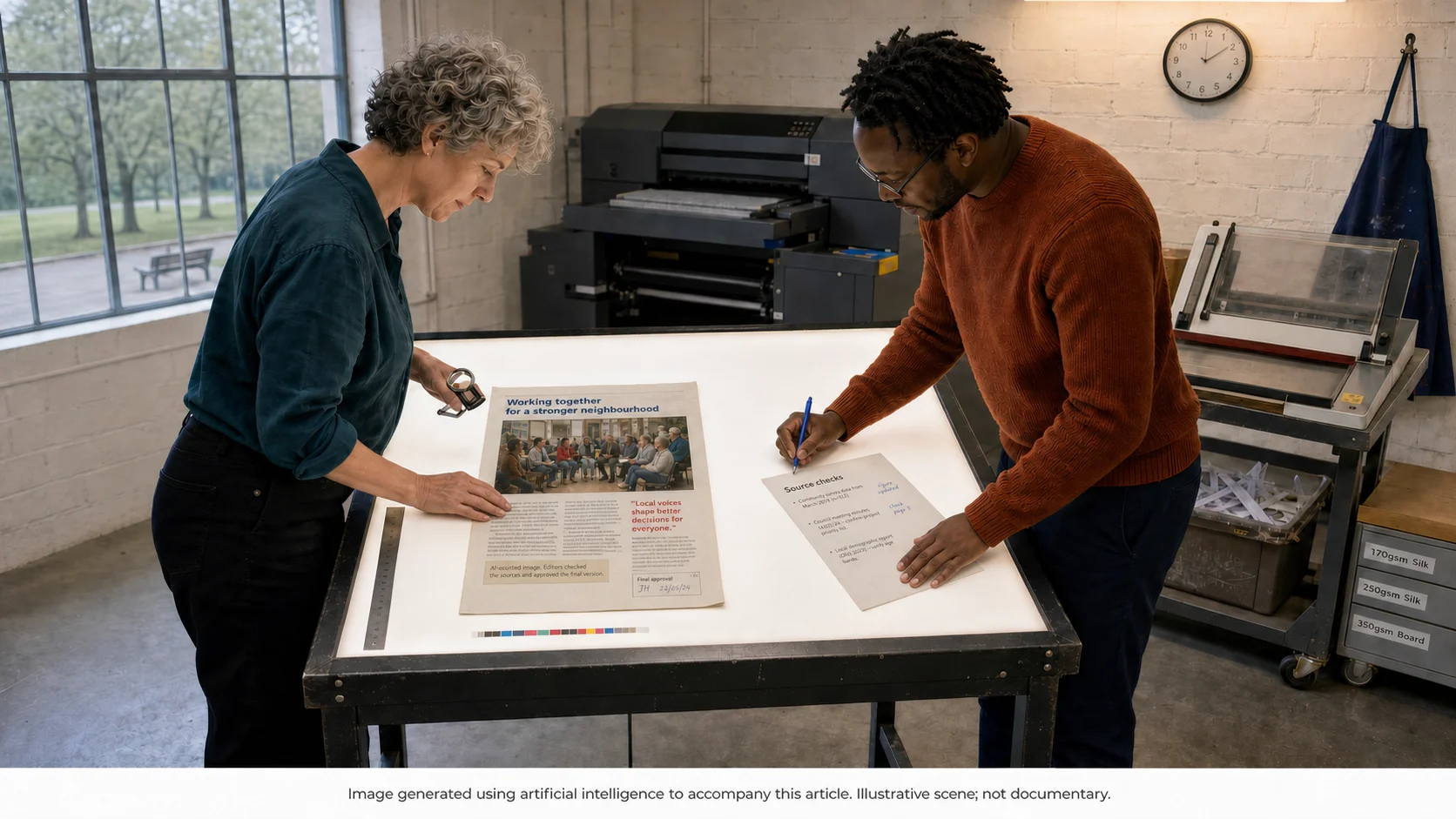
Synthetic image | “Image generated using AI”. | “Conceptual image generated by AI under editorial guidance. It does not depict a real person, place or event.” |
Translation | “Translation carried out using AI.” | ‘The AI produced a first draft. The text was reviewed for meaning, terminology and cultural appropriateness before publication.’ |
Automated assistant | “AI-powered service”. | “You are interacting with an AI assistant. It can find general information, but it is no substitute for the support provided by our team. Here you can find out how your data is used and contact a member of staff.” |
The difference is simple: the generic notice names the technology; the useful statement explains the process, the limitation or the responsibility.
How to present human review credibly
‘Reviewed by a human’ can also become an empty label. Was only the spelling checked? Were the sources verified? Did anyone assess the tone, rights or potential harm?
The Government Communication Service’s policy distinguishes between static content and dynamic services. In a press release or a printed piece, oversight forms part of the production and approval process. In a chatbot or interactive service, this also includes configuration, testing, and evaluation before going live.
For communications, a credible review can be organised around four checks:
- Accuracy: facts, sources, names, dates and context.
- Editorial review: tone, clarity, omissions and possible interpretations.
- Risk: privacy, rights, bias, cultural sensitivity and reputation.
- Approval: the person or role responsible for the final version.
Human review is not a quick read-through once the piece is finished. It is a decision-making process with a defined scope and accountability.
How to avoid transparency that reveals everything
Going into every technical detail doesn’t help either. A note listing models, versions, instructions, intervention percentages and every adjustment can place a burden on the public that is the organisation’s responsibility.
Transparency should be proportionate to the risk of confusion. A practical way to organise it is to work in layers.
First layer: what is necessary for interpretation
A brief, prominent statement alongside the content: ‘Conceptual image generated using AI; does not represent a real event’.
Second layer: further information
A link to the editorial policy or methodology can explain permitted uses, the checks carried out, data protection and rights, labelling criteria and the channel for reporting errors.
The European Commission states that the European icons for labelling AI-generated or AI-manipulated content are optional, although the legal labelling obligations do not apply to the cases covered. Its user tests showed better results when a text label accompanied the basic icon. The Commission also recommends plain language and allows for a second interactive layer with further information.
The icon can provide guidance. Words still do the job of explaining what it means in that specific case.
How to document this internally without creating new red tape
Record-keeping should be proportionate. There is no need to open a file for every correction, but a record should be kept when the use may affect accuracy, authenticity, rights or reputation.
A simple record might include:
- item or project and date;
- tool and version, where relevant;
- purpose and type of intervention;
- sources or materials introduced;
- person responsible for the review;
- checks carried out;
- decision regarding the public statement;
- final approved version and subsequent developments.
Technical traceability allows publishers and platforms to retrace the journey of a piece. Still, it is up to the team to explain to the public which elements of that process are relevant to interpreting it correctly.
Useful transparency: less formula and more context
Communicating the use of AI should not feel like a confession or a clause designed to shift responsibility. Nor does it need to become the focus of every piece.
Useful transparency highlights what might alter the interpretation of the content: what the AI created or modified, what the human team verified, what limitations the result has, and who is accountable for it.
Before publishing, the crucial question is not ‘Have we mentioned that we use AI?’ It is this: have we given the public the information they need to interpret what they are seeing, reading or hearing correctly?
If you work in institutional, public or social communication, I’d love to hear from you on LinkedIn: what information would make a statement about the use of AI truly useful to you?
Frequently asked questions
When should the use of AI be disclosed, and when should it not?
It is advisable to explain this when AI significantly alters the content, may cause confusion about its authenticity, is involved in a direct interaction, or deals with sensitive information or matters of public interest.
A spelling correction, an internal suggestion regarding structure or technical assistance that does not alter the meaning may require internal judgement and documentation, but not necessarily a public disclosure. Legal obligations should be checked on a case-by-case basis.
Which phrases work and which sound hollow?
Phrases that work explain what the AI did, what checks were carried out, and what the public needs to know. ‘AI-generated content’ identifies the technology. ‘Conceptual image generated by AI; does not depict a real event’ also helps the audience to interpret it.
How can human review be presented credibly?
The scope must be specified: fact-checking, editorial review, rights and bias checks, and final approval. The phrase ‘reviewed by a person’ adds little value if it does not clarify what was reviewed or who bore responsibility.
How can we avoid excessive transparency that confuses?
The information can be organised in layers. The first layer should be brief, visible, and sufficient for interpreting the content. A second layer can explain the methodology, tools, review criteria and editorial policy.
How can the use of AI be documented internally?
For sensitive applications, it is advisable to record the tool used, the purpose, the intervention carried out, the sources used, the review process, the person responsible, the labelling decision and the approved version. This record facilitates consistency and enables a response to errors without turning every minor task into red tape.
Editor’s note
This article is based on the topic, approach and editorial criteria defined by me. Artificial intelligence tools were used in its preparation to support the documentation, organise the content and produce a first draft. Before publication, I reviewed the data, the linked sources, the context, the tone and the final wording. I, Laura Mellado, have approved this version and take editorial responsibility for its content.