
Expert
Culture for civic repair: how to reopen public dialogue
Cultural practices can support civic repair by creating recognition, shared presence and institutional learning without reducing culture to propaganda.


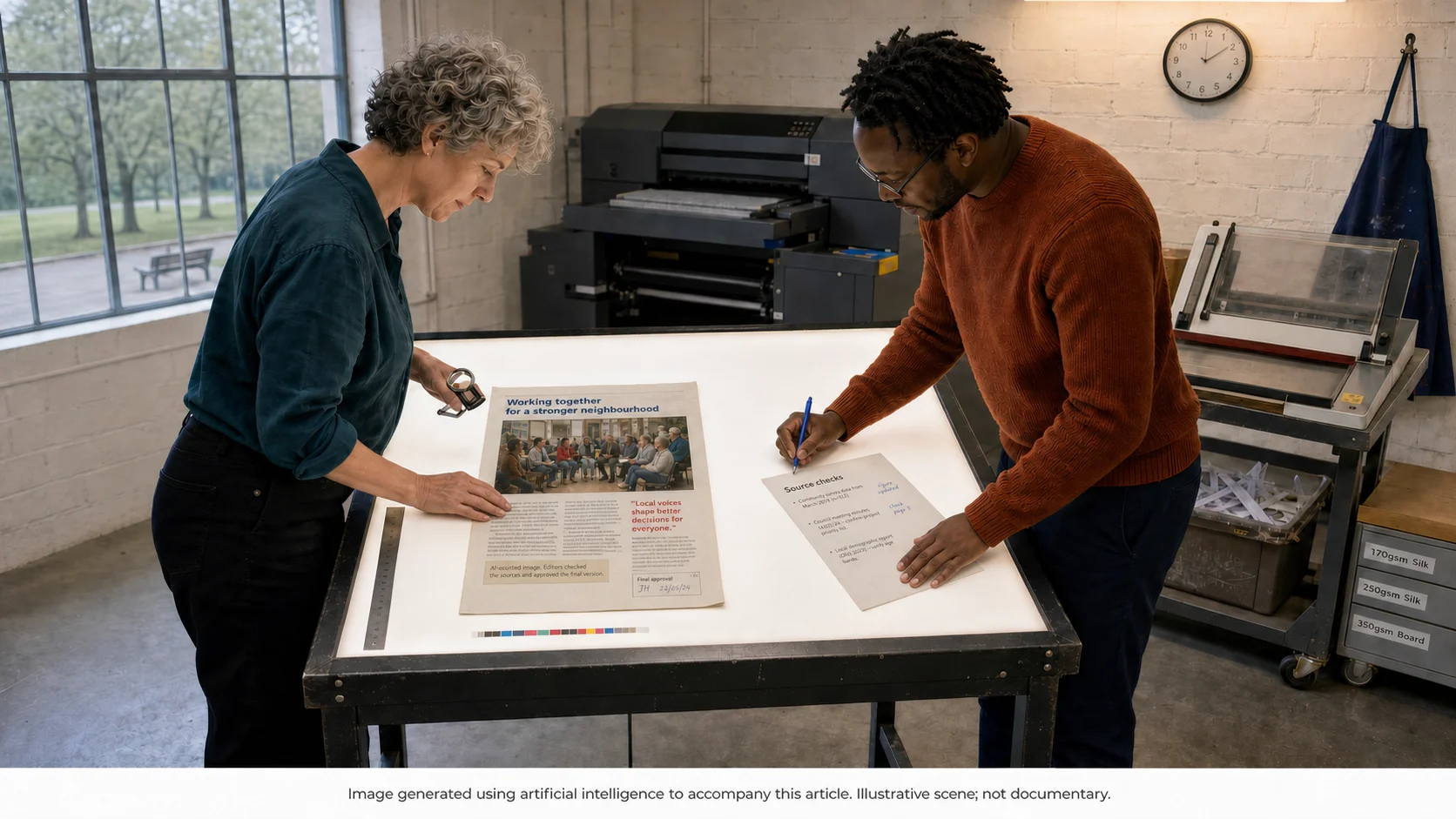
An organisation publishes an image, a report or a campaign and adds a phrase such as this: ‘Content generated using artificial intelligence’.
It seems like a transparent statement.
However, it leaves a few important questions unanswered: what part was created by the tool? Did anyone check the data? Does the image depict a real scene? Who is responsible for the published version?
The problem isn’t in acknowledging that AI has been used. It lies in stating it in a way that doesn’t help the audience interpret the content.
A useful statement explains what the tool did, what control the human team retained, and what the public needs to know. When that information is missing, the disclaimer can seem like a defensive formality: it protects the publisher, but adds little for those who read, watch or listen.
The use of AI is already part of the day-to-day work of many communications teams. The problem arises when that use moves beyond internal use and reaches the public: at that point, a decision must be made about what to explain, how to do so and what the regulations require, without turning every piece of content into a defensive disclaimer.
Concealing a significant AI intervention can erode credibility if it is later discovered. But simply adding a generic label does not guarantee trust either.
In 2025, Oliver Schilke and Martin Reimann studied the effect of disclosing the use of AI in thirteen experiments, involving different tasks and participant profiles. In these controlled settings, people who reported using AI received lower trust ratings. The authors attributed part of this effect to a lower perceived legitimacy.
This result does not prove that transparency is a mistake. It does, however, highlight an important point: stating that AI has been used can raise new doubts about the effort, ability, authenticity or accountability of the author.
The reaction also depends on the context. An experiment published in 2025 by a team from the Universities of Amsterdam and Twente found that the ‘AI’ label reduced the intention to share political news. However, it did not increase the perception of manipulation. The evidence continues to grow and does not allow for a one-size-fits-all approach.
That is why it is important to distinguish between declaring the use of a tool and explaining an intervention. The first option states that AI was used. The second helps to understand the consequences of its use.
Before writing a label, a team should distinguish between the legal obligation, editorial judgement and internal record-keeping. Mixing these three aspects often leads to two extremes: labelling every task out of fear, or leaving the entire decision to the intuition of the person who publishes the content.
Article 50 of the European Artificial Intelligence Regulation sets out transparency obligations for specific situations. These include direct interaction with certain AI systems, the technical labelling required of providers, the disclosure of deepfakes, and the disclosure of certain texts generated or manipulated by AI on matters of public interest.
These obligations will apply from 2 August 2026. The guidelines published by the European Commission on 20 July 2026 clarify the scope, concepts, exceptions and how to demonstrate compliance.
The regulation sets out legal minimum requirements. This article is not a substitute for a legal review of each case.
The editorial criterion raises a broader question: does knowing the role of AI change the correct way to interpret this content or interaction?
A conceptual image may not fall within the legal definition of deepfakes and yet still require clarification if it appears to depict a real place or person. A translation may have undergone human review and still require context if it adapts sensitive terms. An automated response may be well configured, but it must make clear what it can resolve and how to contact a person.
This decision should form part of an AI editorial policy for communications teams, rather than being resolved with an off-the-cuff remark at the end of the process.
Some uses do not require a public explanation, but do require internal traceability. The public does not need to know about every correction, test or tool. The organisation, on the other hand, should be able to reconstruct what was done, who reviewed the result and which version was approved.

Before publishing, it helps to answer five questions:
The more ‘yes’ answers there are, the greater the need to provide a visible and specific explanation.
A chatbot, a conversational avatar or an automated service should be clearly identified. The person needs to know that they are not speaking to a human being, what the system is for, what its limitations are and how to access human assistance when necessary.
The UK Government Communication Service’s policy on generative artificial intelligence requires that the public be notified when they are interacting with an AI-powered service. It also requires an explanation of the extent to which, and for what purpose, such interactions may be recorded or used.
A synthetic image can serve as an editorial resource. The difficulty arises when it appears to document something that never happened.
In such cases, the label ‘AI-generated image’ provides basic information, but may fall short. It is more useful to state: ‘Conceptual image generated by AI. It does not represent a real event or location’.
The AI Act stipulates that content falling within the legal definition of deepfakes must be clearly identified as generated or manipulated by AI. In the case of works that are clearly artistic, creative, satirical or fictional, the notice may be adapted so as not to hinder their display or enjoyment. For communications teams, in addition to checking whether there is a legal obligation, it is advisable to assess the risk of the public mistaking the content for a real person, voice, or event. This criterion aligns with the need for a deepfake response plan in situations where an organisation’s identity or voice may be manipulated.
Greater caution is required if the content concerns rights, health, elections, public funding, education, migration, the environment, security, or institutional decisions.
Article 50 provides for the disclosure of certain texts generated or manipulated by AI that are published to inform the public about matters of public interest. The obligation does not apply where such text has undergone human review or editorial oversight and a natural or legal person retains editorial responsibility.
This qualification is limited to that specific type of text. It does not serve as a general exception for images, audio, videos or any other content reviewed by a person.
A spelling correction has little effect on the meaning. A summary that decides which arguments to omit can significantly alter that meaning.
It is advisable to explain the intervention when the AI creates a substantial part of the content, selects or prioritises information, transforms testimonies or data, imitates an identity, adapts the meaning of a message or generates an automated response in a sensitive context.
The expectations surrounding the relationship also matter. A communication addressed to a victim, a member of the public or an affected community is interpreted differently depending on whether it comes from a person or an automated system.
A useful statement can be brief. To achieve this, it needs to answer four questions.
It is advisable to specify the intervention: did it prepare an initial translation, generate a conceptual image, help organise documentation, summarise responses, create a synthetic voice or produce a first draft?
The statement should explain the actual oversight: verification of data and sources, review of tone and context, checking of the translation, selection of the final version or editorial approval.
This is usually the most valuable part: the image does not depict a real event, the summary is no substitute for the full document, the voice is synthetic, the assistant may make mistakes, or the recreation combines real and artificial elements.
The tool does not sign an article, resolve a crisis or respond to an affected person. The organisation or individual publishing the content retains responsibility for the final version.
Situation | Generic statement | Useful statement |
|---|---|---|
AI-assisted text | ‘This text was created with the help of AI.’ | “AI was used to organise the documentation and prepare an initial outline. The sources, data and final version were reviewed and approved by the editorial team.” |
Synthetic image | “Image generated using AI”. | “Conceptual image generated by AI under editorial guidance. It does not depict a real person, place or event.” |
Translation | “Translation carried out using AI.” | ‘The AI produced a first draft. The text was reviewed for meaning, terminology and cultural appropriateness before publication.’ |
Automated assistant | “AI-powered service”. | “You are interacting with an AI assistant. It can find general information, but it is no substitute for the support provided by our team. Here you can find out how your data is used and contact a member of staff.” |
The difference is simple: the generic notice names the technology; the useful statement explains the process, the limitation or the responsibility.
‘Reviewed by a human’ can also become an empty label. Was only the spelling checked? Were the sources verified? Did anyone assess the tone, rights or potential harm?
The Government Communication Service’s policy distinguishes between static content and dynamic services. In a press release or a printed piece, oversight forms part of the production and approval process. In a chatbot or interactive service, this also includes configuration, testing, and evaluation before going live.
For communications, a credible review can be organised around four checks:
Human review is not a quick read-through once the piece is finished. It is a decision-making process with a defined scope and accountability.
Going into every technical detail doesn’t help either. A note listing models, versions, instructions, intervention percentages and every adjustment can place a burden on the public that is the organisation’s responsibility.
Transparency should be proportionate to the risk of confusion. A practical way to organise it is to work in layers.
A brief, prominent statement alongside the content: ‘Conceptual image generated using AI; does not represent a real event’.
A link to the editorial policy or methodology can explain permitted uses, the checks carried out, data protection and rights, labelling criteria and the channel for reporting errors.
The European Commission states that the European icons for labelling AI-generated or AI-manipulated content are optional, although the legal labelling obligations do not apply to the cases covered. Its user tests showed better results when a text label accompanied the basic icon. The Commission also recommends plain language and allows for a second interactive layer with further information.
The icon can provide guidance. Words still do the job of explaining what it means in that specific case.
Record-keeping should be proportionate. There is no need to open a file for every correction, but a record should be kept when the use may affect accuracy, authenticity, rights or reputation.
A simple record might include:
Technical traceability allows publishers and platforms to retrace the journey of a piece. Still, it is up to the team to explain to the public which elements of that process are relevant to interpreting it correctly.
Communicating the use of AI should not feel like a confession or a clause designed to shift responsibility. Nor does it need to become the focus of every piece.
Useful transparency highlights what might alter the interpretation of the content: what the AI created or modified, what the human team verified, what limitations the result has, and who is accountable for it.
Before publishing, the crucial question is not ‘Have we mentioned that we use AI?’ It is this: have we given the public the information they need to interpret what they are seeing, reading or hearing correctly?
If you work in institutional, public or social communication, I’d love to hear from you on LinkedIn: what information would make a statement about the use of AI truly useful to you?
It is advisable to explain this when AI significantly alters the content, may cause confusion about its authenticity, is involved in a direct interaction, or deals with sensitive information or matters of public interest.
A spelling correction, an internal suggestion regarding structure or technical assistance that does not alter the meaning may require internal judgement and documentation, but not necessarily a public disclosure. Legal obligations should be checked on a case-by-case basis.
Phrases that work explain what the AI did, what checks were carried out, and what the public needs to know. ‘AI-generated content’ identifies the technology. ‘Conceptual image generated by AI; does not depict a real event’ also helps the audience to interpret it.
The scope must be specified: fact-checking, editorial review, rights and bias checks, and final approval. The phrase ‘reviewed by a person’ adds little value if it does not clarify what was reviewed or who bore responsibility.
The information can be organised in layers. The first layer should be brief, visible, and sufficient for interpreting the content. A second layer can explain the methodology, tools, review criteria and editorial policy.
For sensitive applications, it is advisable to record the tool used, the purpose, the intervention carried out, the sources used, the review process, the person responsible, the labelling decision and the approved version. This record facilitates consistency and enables a response to errors without turning every minor task into red tape.
This article is based on the topic, approach and editorial criteria defined by me. Artificial intelligence tools were used in its preparation to support the documentation, organise the content and produce a first draft. Before publication, I reviewed the data, the linked sources, the context, the tone and the final wording. I, Laura Mellado, have approved this version and take editorial responsibility for its content.
Cultural practices can support civic repair by creating recognition, shared presence and institutional learning without reducing culture to propaganda.

Media literacy should not sound like a lecture. Its value lies in helping people read, question, verify and participate more thoughtfully. Spotting a hoax is the starting point, not the destination.

Diverse voices in a multi-stakeholder programme are not the problem. The problem is the absence of an architecture that organises them without silencing them. How to design narrative coherence when multiple actors, logics and audiences must communicate the same programme without fragmenting or becoming uniform.