How to say ‘no’ with institutional dignity
Saying ‘no’ should sound neither cold nor apologetic.
A dignified ‘no’ has four elements:
Acknowledgement: the organisation demonstrates that it has understood the expectations of the person or organisation concerned.
Reasoning: it explains which rule, priority or evidence was applied.
Limits: it clarifies what could not be changed, published, or promised.
Next step: indicate whether there is an appeal process, a new call for applications, a channel for enquiries, planned learning, or further information.
A structure would be:
“We understand that this decision may cause frustration. The assessment was carried out in accordance with the published criteria: [criteria]. In this case, [specific reason]. The main constraint was [budget/places/mandate/confidentiality]. From now on, [next step].”
This is not a template for glossing over a decision. No amount of wording can make up for a poorly designed process.
However, a good structure avoids two extremes: opaque silence and a never-ending explanation.
Sometimes, saying ‘no’ with dignity means accepting that the other person will continue to disagree. Communication does not have to create consensus. It must foster understanding, transparency, and respect.
What to publish and what to keep private without becoming opaque
An organisation cannot publish everything. Nor should it promise to do so.
There is information that must be withheld for reasons of data protection, confidentiality, security, professional secrecy, legitimate commercial interests, or the integrity of the process. Article 41 of the Charter of Fundamental Rights itself recognises the right of access to the file, but balances this against legitimate interests of confidentiality and professional secrecy.
The key point is not to publish every detail. It explains the criteria for publication and for withholding information.
A useful statement might be:
“We publish the criteria, the procedure, the aggregated results, and the lessons learnt from the process. We withhold personal data, confidential information relating to applications and information protected by applicable regulations.”
This kind of wording helps because it shows that withholding information is not arbitrary. There is a reason for it.
A European case illustrates this tension well: the debate over public access to documents relating to COVID-19 vaccine contracts. The Court of Justice of the European Union explained in 2024 that the General Court had partially annulled the Commission’s decisions on access to documents because it had not sufficiently demonstrated that broader access to certain elements would harm commercial or privacy interests.
The matter was still ongoing in 2026: according to Reuters, Advocate General Athanasios Rantos recommended dismissing the Commission’s appeal against the 2024 judgement. His opinion is not binding, but it keeps alive a very clear public debate on transparency, confidentiality, and accountability.
The case does not serve to argue that everything must be made public. It serves to demonstrate something more useful: when there are legitimate limits, explaining those limits is also part of building trust.
Message frameworks for calls for applications, selection processes and consultations
Rigid templates often fall short. When making difficult decisions, it is best to work with message frameworks that each team can adapt.
For a call for proposals where no award is made
Decision: “Your proposal has not been selected in this call for proposals.”
Criteria: “The assessment was carried out based on [published criteria].”
Constraint: “The number of proposals eligible for funding was limited by [budget/places/scope].”
Feedback: “You can view [a summary/the criteria/aggregated results] and apply for [the next opportunity], if applicable.”
For a project selection
Decision: “[Number] projects have been selected.”
Criteria: “The selection prioritised [criteria].”
Limit: “The call for proposals did not allow for the funding of projects outside [scope/territory/deadline].”
Response: “We are publishing a summary of the process and have opened a channel for procedural enquiries until [date].”
For a public consultation
Decision: “Following the consultation, [element] is retained/amended/incorporated.”
Criteria: “The contributions were analysed according to [criterion].”
Limitation: “Some aspects fell outside the remit of this phase.”
Feedback: “This summary shows which contributions influenced the decision and which could not be incorporated.”
The structure is simple. But it forces you to think before you write.
Questions a team should ask itself before communicating
Before publishing a sensitive decision, a communications team can ask itself five very specific questions:
What does a person affected need to understand to recognise that the decision has been made judiciously, even if they do not agree with it?
What criteria are applied, and where are they published or explained?
What limitations exist, and which ones should be mentioned before they come across as an excuse?
Which parts of the information can be published, and which parts should be withheld, with a clear reason given?
What feedback will those who participated, applied, contributed, or were excluded receive?
These questions do not replace legal, technical, or political work. They structure it so that communication is not delayed.
Because a difficult decision does not become more credible simply by sounding certain, it is more likely to be recognised as reasonable when it allows the process to be seen with sufficient clarity.
Conclusion
Communicating difficult decisions requires a delicate balance: clarity without harshness, prudence without opacity, and empathy without promising what cannot be changed.
The useful question is not ‘how do we defend this decision?’
It would be better to ask: what does a reasonable person need to know to understand how it was reached, what constraints were involved, and what might happen next?
If you work in institutional, social, or public engagement contexts, I would be interested to read your thoughts on LinkedIn: where does trust break down first – in the criteria, the limits, the tone, or the feedback?
Frequently asked questions
What is the difference between explaining things in good time and justifying oneself afterwards?
Explaining in good time is a proactive gesture: it sets out criteria, process, boundaries, and next steps before the organisation must respond under pressure.
Making excuses is usually reactive. It arises when there is already suspicion, criticism or a request for explanations that were not provided clearly enough beforehand. It does not always have an aggressive tone; it can be a correct and polite text. But it comes too late and serves a defensive purpose.
The difference is evident not only in the tone but also in the structure. An explanation sets the process in motion. A justification attempts to protect it once it is already being questioned.
What is the difference between being accountable and taking responsibility?
Accountability means explaining what was done, why, on what basis and with what consequences.
Taking responsibility goes one step further. It involves accepting the consequences of a decision, responding when something goes wrong, correcting the situation if necessary, and not hiding behind procedure.
How can we communicate criteria and limits without undermining trust?
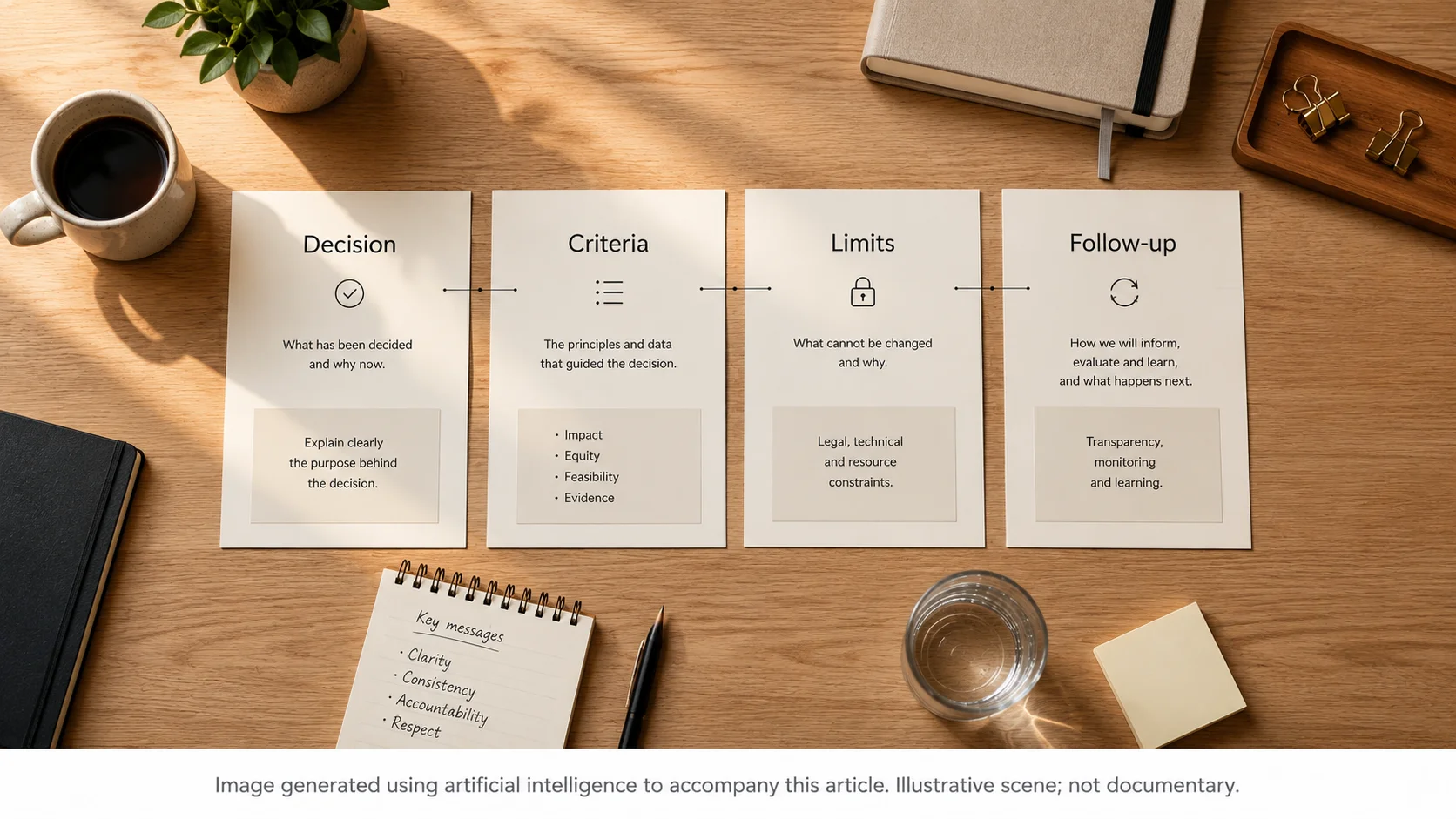
It is helpful to distinguish between four layers: what was decided, on what criteria, within what limits, and what feedback those affected receive.
When these layers are made clear, disagreement may still exist, but the sense of arbitrariness is reduced.
How can one say ‘no’ whilst maintaining institutional dignity?
An institutional ‘no’ should acknowledge the expectation, explain the criteria applied, state the limit and offer a next step.
There is no need to dramatise or harden the message. The person needs to understand why the answer is negative and what options remain.
What information should be published and what should be kept confidential?
It is advisable to publish criteria, procedures, aggregated results, timelines, avenues for appeal or consultation, and lessons learnt from the process.
Personal data, confidential information, professional secrets, information protected by regulations, or details that could compromise the integrity of the process should be withheld. The key is to explain the criteria for what is published and what is withheld.
How can we close the loop with affected or participating members of the public?
Closing the loop means explaining what happened after listening: which contributions were taken on board, which could not be incorporated and why, what is changing now, and which channels remain open.
Without this feedback, participation may seem merely tokenistic.
What structure works best for calls for proposals, selection processes, or consultations?
A useful structure comprises four sections: decision, criteria, limitations, and feedback.
First, the specific decision is stated. Next, the criteria are explained. Then, the actual limits of the process are clarified. Finally, it indicates what the affected person, organisation, or community can do next.
Editor’s note
This article is based on an editorial line and approach defined by me, Laura Mellado. Artificial intelligence tools have been used to assist with research, structuring, and editing. The final version has been reviewed, verified, and approved by me.