Communication with values: Weaving trust in the age of disinformation

Diverse hands interlaced, glowing gold and pale-blue threads symbolising trust and values-driven communication.

There was a time when “seeing is believing” was the norm. Today, in the blink of an eye, a video created with artificial intelligence (AI) or a misleading article can alter our perception of reality and erode trust. Did you know that, according to an EU survey, 71% of Europeans encounter fake news on the internet several times a month, and 30% do so daily? 

 The challenge of disinformation is not new. However, the breakthrough of AI makes these capabilities available to anyone, even without advanced technical knowledge. For those of us in communications, this issue extends beyond a technological problem; it is a deeply human concern. The paradigm has shifted: digital presence no longer requires only being visible but must be accompanied by a commitment to our ethical principles. 

So, how do we move from communication that is reactive to one that is grounded in our values? How can we rebuild trust in a society where confusion seems to travel faster than truth? In this article, I share some reflections to understand the great challenge ahead. 

Clarifying concepts: Disinformation, misinformation and FIMI 

Academia and large technology companies often have their own ways of classifying disinformation. To simplify, we can understand disinformation as false information intentionally created and disseminated to mislead or manipulate. It is precisely this intention that distinguishes it from misinformation, which is false or inaccurate content shared without the intention of causing harm, often because the disseminator believes it to be true. 

In the field of geopolitics, we also frequently hear about Foreign Information Manipulation and Interference (FIMI) operations. These are coordinated actions by state or non-state actors aimed at manipulating the information environment in other countries, creating division or destabilising democratic processes. 

Although their origins and intentions vary, and in practice it is not always easy to distinguish between them, all these forms of information have a typical result: they undermine public trust, distort debate and hinder citizen participation. Their effects are palpable: polarisation, persistent misinformation and a growing sense of uncertainty. 

Manipulation uncovered: A strategic approach 

A strategic approach to tackling disinformation is not limited to the content. While fact-checking initiatives are essential, it is imperative to implement other measures that weaken the whole system of manipulation. To comprehensively understand how manipulation works, we can use the ABCDE framework developed by James Pamment. This framework invites us to analyse:  

  • Actor: Who is behind the message? Knowing the sender helps us to understand their possible motivations and interests. 
  • Behaviour: How is the message being disseminated? Examining distribution channels and patterns provides insight into intentionality and reach. 
  • Content: What is said and what is omitted? Analysing the message itself, paying attention to the information present and absent, is the central element in identifying bias or misrepresentation. 
  • Degree: How intensively is it being promoted? The frequency and emphasis with which a message is disseminated may indicate a coordinated campaign. 
  • Effect: What impact does it have on individuals and communities? Assessing the consequences of the message on public perception and social cohesion allows us to understand its actual reach. 

Six values for responsible communication: A legacy of trust 

Information manipulation is not a new phenomenon; in fact, one of the earliest examples in history dates back to Constantine’s donation. All these situations have one thing in common: the spread of rumours. That is why, in proposing our values for responsible communication, I suggest that you take inspiration from the six guidelines for effective rumour control that Robert Knapp established in 1944. These guidelines, though old, resonate with surprising timeliness in today’s society. 

Brass compass and leather notebook on ethics atop vintage map, portraying an ethical compass guiding honest communication.

Transparency: Truth as a starting point for trust 

Knapp’s first guideline encourages us to ensure the integrity of our communication channels. To achieve this, transparency and honesty must be our first filter. When we share information, it is essential to verify its veracity before disseminating it. We should always cite the sources and contextualise what we say. And if we make a mistake, we must ensure that we correct it visibly and honestly. Let us remember that building a culture of responsible communication starts with the example we set. 

Critical thinking: The key to discernment in a noisy world 

Knapp’s second guideline underlines the importance of developing maximum trust in leaders. To achieve this, citizens must have the fundamental skills to foster critical thinking and media literacy. As consumers of news, this involves asking who created a piece of content and for what purpose, recognising our own emotional and confirmation biases, and learning how hoaxes and conspiracy theories operate. 

Educating young people is undoubtedly essential, but we cannot forget other segments of society, such as older people, who may not have the same technological skills. Education in critical thinking must also extend to the family environment and through community referents, ensuring that no one is left behind in this vital skill. 

Coherence: Leading by example, beyond words 

Knapp’s second guideline also has an institutional component. Organisations and institutions have a decisive responsibility to communicate clearly and humbly. Launching slogans and public campaigns is essential, but it is insufficient if we want to build trust. That is why their actions speak louder than any inspirational message. 

This involves fostering safe spaces for dialogue and denouncing misinformation, always providing evidence. For example, during crises such as the COVID-19 crisis, leaders who reported with evidence and empathy helped to reduce fear and rumours, demonstrating that consistency between what is said and what is done is essential. 

Agility: When truth needs speed 

Knapp’s guidelines also address the dissemination of ideas. He advises: “Spread as much news as possible, as fast as possible”. In this area, technology becomes a great ally, mainly when we communicate proactively. As Nicholas J. Cull rightly points out in his book Reputational Security: “In tactical counter-propaganda, the defender is forced to fight on his adversary’s chosen terrain”. To disseminate information quickly without sacrificing accuracy, there are a few practices to consider: 

  • Create agile protocols that allow us to respond quickly to fake content. 
  • Collaborate with trusted local voices who can amplify truthful messages in their communities. 

Accessibility: Ensuring that information reaches everyone 

Knapp recommends “making information as accessible as possible”. Here, the channel of communication plays a key role. Technology and social media make this task much easier, but we must ensure that the information is not only accessible but also secure. Some practical ideas to achieve this include using clear and inclusive language, adapting formats according to the digital access of each audience, and promoting the configuration of privacy filters and the ability to report inappropriate content 

In addition, it is important to reflect before publishing: Is what I am going to share really necessary? Is it respectful? Does it add value? 

Community care: Fostering spaces for enriching dialogue 

This value is paramount in implementing Knapp’s fifth pillar, which advises avoiding boredom, monotony and personal disorganisation. Building inclusive and respectful digital communities can foster an exchange of ideas based on fundamental principles. This involves setting clear rules and applying active moderation to maintain a healthy environment. 

It is essential to value constructive contributions that enrich the conversation and encourage intercultural and empathetic dialogue, where different perspectives are heard and respected. Initiatives such as #SpreadNoHate or the Strong Cities Network are clear examples of how community action can effectively counter hate speech and manipulation, demonstrating the true value of human connection.

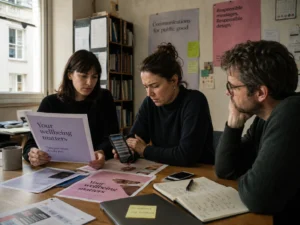
Diverse professionals in a sunlit coworking space around a large table, demonstrating collaborative, value-led communication.

A shared commitment to communication 

Knapp’s sixth and final guideline guides us to our final piece of advice: an effort to 

The phenomenon of manipulation goes beyond facts; it is based on a “deliberate campaign against the spread of rumours”. The phenomenon of manipulation goes beyond the facts; it is rooted in a confidence crisis and there is no technical shortcut that can solve tit. But we can have something powerful: our values. 

Communicating with honesty, respect, and empathy is not naivety; it is a commitment that builds better realities. And, above all, it is an imperative need. This is a shared task, a daily responsibility to communicate with care, clarity and courage. I invite you to ask yourself: 

Am I reporting, or am I connecting? 

Let’s make connection our compass. I’d love to hear from you: what strategies do you use to promote responsible communication in your daily life? 

Share your ideas with me on LinkedIn. You can also read other articles on my blog to explore these and other communication topics further.

Related entries:

Institutional communication in closed messaging platforms
Expert

Institutional communication in closed messaging platforms

Institutions keep designing messages for public feeds while their audiences make decisions in WhatsApp groups no institutional algorithm can reach. The problem is not technical. It is a question about how trust works when public visibility disappears and what remains are relationships.

Read more »