
Expert
How to communicate difficult public decisions without sounding defensive
A decision may be well-founded yet still come across as poorly explained. This happens in a call for proposals where many organisations are left out.


The diversity of voices in a multi-stakeholder programme is not an obstacle to narrative coherence. What hinders it is the absence of a framework that organises these voices without silencing them.
Many European programmes bring together EU institutions, Member States, implementing agencies, NGOs, development and financing banks, private companies and local partners, each with their own technical teams. Each organisation has its own language, priorities, legitimacy and relationship with its audiences.
When well designed, this is a strength.
But when that communicative diversity lacks shared criteria, it ceases to be plurality and becomes noise. And noise, in programmes that depend on institutional trust, comes at a cost: it confuses, wears people down and can weaken the public’s perception of the impact.
In short, narrative coordination is not about making everyone say the same thing. It is about designing what should be common, what can be adapted, and which voice lends the most credibility in each context.
Narrative coordination is the system that enables various actors to communicate the same programme coherently, even if they do not use the same words.
It serves to answer questions such as these:
This approach is particularly important in European programmes, where communication does not usually depend on a single team. It depends on a network.
The European Commission defines Team Europe Initiatives as initiatives focused on critical priorities where a coordinated and coherent effort by Team Europe can deliver results with transformative impact. Team Europe brings together the European Union, the Member States, their implementing agencies, public development banks, the European Investment Bank and the European Bank for Reconstruction and Development.
In other words, we are talking about structures where coordination is not an operational detail. It is part of the model.
When an institutional network communicates in a fragmented way, the usual reaction is often to produce more materials: a style guide, a template, a common presentation, a logo bank, a shared calendar.
All of that can be useful.
But it rarely solves the underlying problem.
Narrative fragmentation is not due to a lack of materials. It arises because the criteria guiding communication have not been agreed upon beforehand:
What principles underpin the programme, which messages are central, which topics cannot be freely reinterpreted, and where it makes sense for each stakeholder to speak in their own voice.
Without that prior agreement, each partner interprets the common objectives from their own communicative framework. The result may be coherent piece by piece, but confusing when viewed from the outside.
One institution talks about strategic investment.
An implementing agency talks about technical results.
A local NGO discusses rights, access, or vulnerability.
A local partner talks about community impact.
None of these voices is wrong. The problem arises when no one has defined how they should coexist.

In EU-funded programmes, communication and visibility are obligations for beneficiaries. The European Commission reminds us that recipients of European funds must acknowledge the source of the funding, use the EU emblem correctly, communicate accurate information and, depending on the programme, prepare specific communication and dissemination activities. Source: European Commission — Communicating and raising EU visibility
Furthermore, in EU external actions, the official guidance states that, where strategic communication is planned, the implementing partner must produce a Strategic Communication Plan. It also emphasises that communication activities must be data-driven and aligned with the EU’s strategic communication plans. Source: European Commission — Guidance for External Actions
This is important because there is often confusion: the assumption that a visibility plan is equivalent to a narrative architecture.
It’s not the same thing.
A visibility plan defines how the programme will look.
A narrative architecture defines how it will be understood.
Visibility addresses questions such as: where the logo appears, how funding is acknowledged, which channels are used, and what materials are produced.
Narrative architecture addresses another set of questions: what shared story underpins the programme, how its limitations are explained, how results are communicated, how tensions are addressed, and how coherence is maintained when many stakeholders are speaking.
Both are necessary. But they do not do the same job.
The symptoms are recognisable to anyone who has worked on programmes with multiple partners.
External audiences receive different explanations about the same project depending on who they speak to. Partners use the same words to mean different things, or different words to describe the same thing. Uncomfortable questions — about impact, delays, internal tensions or controversial decisions — are answered inconsistently at each point of contact.
Ultimately, the network conveys a sense of disarray, even though each actor is doing their part well.
The comparative analysis by the Elcano Royal Institute and IDOS of five Team Europe Initiatives examines aspects such as visibility and communication, effectiveness, ownership, and joint planning. The report highlights concerns about the visibility of the initiatives relative to the projects they comprise, as well as a lack of clarity about their relationship with other EU strategic frameworks, such as Global Gateway. It also identifies issues linked to the definition of objectives, funding, timelines and operational added value.
Translated into communication terms: when an initiative lacks a sufficiently clear operational framework, it cannot sustain a coherent narrative over the long term. And this is usually a design issue.
Narrative coherence in multi-stakeholder networks is not built on a single message for everyone. It is built by distinguishing between what must be common and what can — and should — be different.
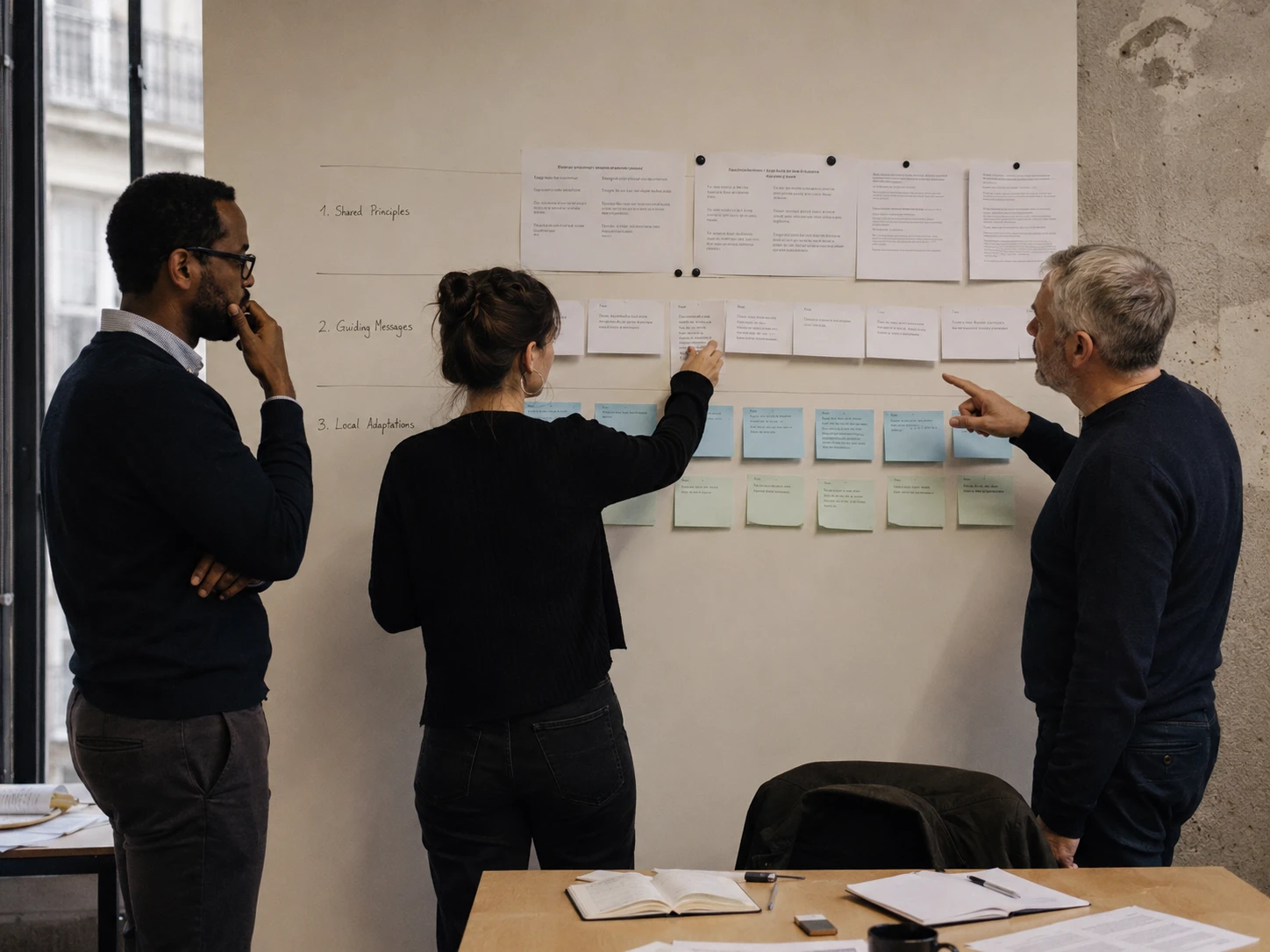
A practical model can be organised into three layers.
The first layer consists of the principles that all actors uphold without exception.
These are not slogans. They are criteria.
In a development cooperation programme, for example, they may include prioritising outcomes for beneficiaries, transparency about constraints, respect for local partners, and rejecting narratives that exploit vulnerability.
These principles serve as a decision-making framework. They help answer a key question:
What kind of communication would be inconsistent with the programme’s values, even if it were effective in terms of visibility?
Without this layer, messages may sound correct, but they lack substance.
The second layer consists of guiding messages: clear statements on the programme’s core themes.
They should not function as set phrases that everyone repeats. They should function as agreed positions.
For example:
These messages free stakeholders from the need to improvise under pressure.
And in institutional contexts, that matters a great deal.
The third layer is the space in which each actor communicates from their own position to their own audience, based on their own legitimacy.
This layer is not an afterthought. It is not ‘what remains’ after defining the common messages. It is an active design decision.
There are things a European institution can say with authority. There are others that a local partner can say with far greater credibility. Some messages work in Brussels but do not work in the same way in a specific region. There are words that, with one audience, build trust and, with another, create distance.
Designing this layer involves asking:
What can each actor say best, and why?
When this question is not asked, narrative coordination tends to fall into one of two extremes: fragmentation or uniformity.
Coherence and uniformity may look similar in a presentation. In practice, they work very differently.
Narrative coherence | Communicative uniformity |
Allows for different voices within a common framework. | Seeks to ensure everyone repeats the same message. |
It bolsters each stakeholder’s credibility. | It turns partners into spokespersons for the core message. |
Shared criteria underpin it. | It depends on constant approval and monitoring. |
It withstands external pressure better. | It falls apart when the context changes. |
It acknowledges complexity without turning it into chaos. | It simplifies complexity to the point of implausibility. |
A narratively coherent network does not require everyone to say the same thing. It requires everyone to understand why they say what they say.
That difference seems small. But in multi-stakeholder programmes, it can mark the line between trust and confusion.
A three-layer model is of little use without operational support.
Narrative coordination does not sustain itself. Teams change, contexts evolve, partners interpret priorities, tensions arise, and the difficult questions almost always come when there is least room to think.
That is why simple, dynamic and shared tools are needed.
The narrative brief should not be a decorative document. It should function as a starting agreement.
It aims to define:
Its value lies not only in the final document. It lies in the conversations that need to be had.
Because coordination often begins right there: when stakeholders sit down to decide what is common ground, what is negotiable, and what should not be left to chance.
The response bank compiles agreed positions on the questions the programme receives most frequently, especially the awkward ones.
It does not aim to have everyone respond in the same way. It aims to prevent each stakeholder from having to provide a different response at times of greatest public pressure.
It may include questions such as:
The difference between a bank of answers and internal FAQs is significant.
An FAQ usually closes questions.
A live answer bank helps to identify gaps.
When a partner receives a question for which there is no agreed-upon answer, it is not just a one-off communication issue. It is a sign that the narrative architecture needs updating.
The third tool is a shared repository where these materials are available, up to date and linked to practice.
It is not enough to create a folder and then abandon it.
The repository should contain:
In this way, narrative coordination becomes institutional learning.
And in long-standing networks, it is this learning that allows coherence to survive changes in team members, partners, or the political context.
A formal audit is not always necessary to identify the problem. Sometimes it is enough to observe how the network speaks when a difficult question arises.
A network has narrative coherence when its actors answer the same core questions from different but compatible positions.
Each partner can explain the programme in their own voice, with their own emphasis and experience, but the combined result makes sense.
Consistency is also achieved when internal tensions are managed in accordance with a shared set of principles. When messages are adapted to the context without compromising core values. And when things go wrong, the organisation does not need to panic in its communications; it should respond clearly.
A network is consistent when all stakeholders use the same terminology, regardless of their audience.
Local voices amplify the central message but do not contribute their own perspective. Coordination depends on someone reviewing and approving every communication before it is released. And when a stakeholder deviates from the intended message, the only possible response is to correct them from above.
Uniformity can give the impression of control.
But that sense is short-lived.
As soon as external pressure arises—a crisis, public criticism, or an internal change—uniformity reveals its weakness: it relies too much on everyone repeating the message and too little on everyone understanding it.
Before launching materials, campaigns or visibility plans, the communications teams of a multi-stakeholder network should ask themselves a few simple questions.
Simple does not mean easy.
These questions may seem to come before communication. In reality, they are strategic communication at its most serious.
In multi-stakeholder programmes, trust is not built solely on good results. It is also built on how those results are explained, contextualised, and shared.
When a network communicates in a fragmented way, audiences perceive inconsistency even if the technical work is sound.
When a network communicates uniformly, it may appear orderly, but it risks sounding artificial. Especially when local voices lose nuance or when messages do not reflect the real-life experiences of communities.
Narrative architecture helps to avoid both risks.
It allows the programme to have a common voice without erasing the voices that give it credibility.
And that is key in environments where institutional legitimacy can no longer be taken for granted.
The question that many multi-stakeholder networks ask themselves too late is this:
How do we get everyone to communicate the programme more effectively?
But perhaps the useful question comes earlier:
What degree of narrative diversity can this programme sustain without losing coherence?
And also its inverse:
What degree of uniformity are we imposing in the name of coordination that perhaps no one fully controls?
There is no one-size-fits-all answer. It depends on the programme, the actors involved, the political context, the audiences and the commitments at stake.
But asking these questions from the outset changes the starting point.
Because communication in multi-stakeholder programmes does not begin when a press release is drafted, a report is published, or a visibility campaign is designed.
It begins when a network decides what it wants to mean collectively and which voices it needs to preserve so that meaning remains credible.
If you work on communications coordination for a multi-stakeholder programme and recognise any of these tensions, I’d love to hear from you on LinkedIn.
Where does narrative coherence most often break down: in the design, in the implementation, or when the stakeholders change? I look forward to hearing from you.
Narrative coordination is the design of principles, guiding messages and spaces for local adaptation so that various actors can communicate the same programme coherently, without losing their own voice.
Communication becomes fragmented when partners share objectives but do not share narrative criteria, responses to difficult questions, or clear boundaries on what should remain common.
Uniformity aims to have everyone say the same thing. Coherence allows each actor to speak from their own position of legitimacy, always within a common framework.
The most useful tools are the shared narrative brief, the living response bank, the common repository and the criteria for local adaptation.
At the start of the programme. If it is designed when there are already contradictions, public criticism or external pressure, the network operates defensively.
A decision may be well-founded yet still come across as poorly explained. This happens in a call for proposals where many organisations are left out.

A campaign can carry a responsible message while being distributed through an experience that pressures people. Trust is also designed.

Cultural practices can support civic repair by creating recognition, shared presence and institutional learning without reducing culture to propaganda.