
Expert
How to communicate difficult public decisions without sounding defensive
A decision may be well-founded yet still come across as poorly explained. This happens in a call for proposals where many organisations are left out.


You’ve been there. You’re in a meeting, consultation or feedback session and you think: “We’re listening, we’re asking for opinions, we’re being participatory.” But then, when you look back, you realise that the results didn’t change as much as you expected. Or worse: the same people you invited to participate tell you that they felt you didn’t listen to them.
Welcome to the paradox of participation: we talk a lot about listening, but we rarely do it. As strategic communication professionals, facilitators and coordinators of institutional processes, we are trained to “include voices” and “encourage dialogue”. However, we continue to fall into dynamics where listening becomes a formality rather than a tool for transformation.
This thought comes from years of observing participatory processes in different organisational contexts. It is not about pointing fingers, but about understanding why this happens and, above all, what we can do to ensure that our listening processes generate the impact we seek.
One of the biggest mistakes we make is to assume that listening is a neutral act. It is not. Every listening process is permeated by power structures that influence who speaks, what is said, how it is interpreted, and how much weight is given to each voice.
In many organisations, the very design of participatory processes reflects institutional hierarchies. Who decides the format of the consultation? Who defines the questions? In what language is it conducted? At what time? On what platform? Each of these decisions can include or exclude voices in subtle but effective ways.
I have observed sessions where the format favoured people who were comfortable speaking in public, but silenced those who prefer written reflection. Or processes where the questions were framed in conceptual terms that not all participants shared, generating biased or superficial responses.
And that undermines trust.
Therefore, recognising these dynamics does not mean paralysing yourself, but instead designing with greater awareness. Active listening begins before anyone speaks: in how we structure the space, time and conditions so that different voices can emerge authentically.
Symbolic listening is more common than we would like to admit. It is characterised by complying with participation protocols without generating fundamental changes in decisions or process. Here are some signs that may indicate that we are falling into this dynamic:
In the design of the process: Consultations have rigid formats that do not adapt to the needs of participants. Questions are phrased in a way that confirms what we already think rather than opening new perspectives. There is insufficient time for deep reflection.
During the sessions: One or a few voices dominate while others remain silent. Responses are collected, but their meaning is not explored in depth. There is a noticeable rush to “get through the agenda” rather than following the threads of conversation that emerge.
In the follow-up: The results of the consultations take months to be communicated or are never shared. The final decisions do not reflect what was heard, or the connections are forced. Participants express surprise or dissatisfaction with the direction taken.
A useful self-diagnosis is to ask yourself: How many times in the last year has a participatory process significantly changed a decision we had already made? If the answer is “a few” or “none,” we are probably dealing with symbolic listening.
Beyond power structures, there are operational obstacles that limit the effectiveness of our listening processes. Identifying these patterns helps us design better participatory dynamics.
Confusing collection with connection: We often focus on gathering as much information as possible without spending enough time understanding what that information means to those who share it. Collecting data is not the same as building mutual understanding.
Urgency vs. depth: Institutional deadlines rarely coincide with the time needed for deep listening. This pressure leads us to rush processes that require pause, reflection, and multiple iterations.
Failure to close cycles: One of the most frustrating mistakes for participants is not knowing what happened to their contributions. Participatory listening does not end when information is collected; it ends when the impact of that information on decisions is communicated.
Assuming homogeneity: We treat all participants as if they have the same motivations, communication styles, and availability. This homogeneous approach limits the wealth of perspectives we can capture.
Deep listening goes beyond recording what is said; it seeks to understand the context, emotions and needs behind each contribution. To develop this skill, I propose three areas of work:
Listening to the content: What is being said explicitly? Here we apply techniques such as paraphrasing (“If I understand you correctly, what you are proposing is…”) and clarifying questions (“Could you give an example of that?”).
Listening to the process: How is it being said? We observe body language, tone, pauses, and interruptions. We pay attention to who is speaking and who is not, what group dynamics emerge, and what moments generate energy or tension.
Listening to the context: Where is it being said from? We consider the experiences, positions and interests that each participant brings to the space. We understand that the exact words can have different meanings depending on who says them and in what circumstances.
This multidimensional listening requires practice and constant self-observation. A helpful technique is to set aside specific moments during sessions to check understanding: “Before we continue, let me summarise what I have heard and correct me if I am wrong.”
Different formats allow different types of voices and perspectives to emerge. Combining multiple methodologies in the same process increases the chances of capturing the diversity of contributions:
Dialogue circles: Especially useful for sensitive topics or when seeking depth on personal experiences. The circular format promotes horizontality and ensures that every voice is heard.
World Café: Effective for processing multiple topics simultaneously and generating connections between ideas. Rotating between tables allows ideas to be enriched with different perspectives.
Open spaces: Useful when we do not know precisely what issues will emerge or when we want participants to define the priorities for discussion.

Digital tools can amplify listening if used strategically, not as substitutes for human contact but as complements that enable new forms of participation:
Anonymous feedback platforms: These allow perspectives to emerge that might not be expressed in face-to-face spaces due to power dynamics or personality.
Digital collaborative walls: These facilitate the collective construction of ideas and allow all participants to contribute simultaneously, not just those who speak the loudest or fastest.
Reflective surveys: Unlike traditional surveys, these include open-ended questions that encourage reflection and allow you to capture nuances that multiple-choice options do not.
Assessing the effectiveness of our listening processes requires indicators that go beyond quantitative participation:
Qualitative indicators: Changes in the type of conversations generated, emergence of new proposals or unexpected perspectives, expressions of greater confidence in the process by participants.
Closed-loop indicators: Time between consultation and communication of results, percentage of decisions that reflect input received, number of participants who become involved in subsequent processes.
Institutional self-assessment: Frequency with which participatory processes change decisions already made, satisfaction of the facilitating team with the quality of the dialogue generated, and organisational learning derived from the consultations.
Strategic communication in participatory contexts goes beyond informing about processes; it is about creating conditions for dialogue to be possible and fruitful. This includes three key dimensions:
Pre-communication: Explaining not only the what and when, but also the why and what for of participation. Participants need to understand how their contributions will be used and what real influence they have on decisions.
During communication: Facilitate both the exchange of ideas and mutual understanding. This includes translating between different technical languages, making connections between seemingly disparate contributions visible, and managing moments of tension or disagreement.
Post-communication: Close the cycle by communicating the decisions made and the process that led to those decisions, including how the contributions received were considered, what was incorporated, what was not, and why.
In participatory processes involving cultural, generational or sectoral diversity, listening requires specific adaptations that recognise different communication styles and ways of understanding participation.
Some cultures prioritise individual reflection before public expression; others value direct debate more. Some contexts require establishing personal relationships before addressing work issues; others prefer to go straight to the content. It is not a question of stereotyping, but of being attentive to these differences and offering multiple channels for participation.
Intercultural facilitation also involves being aware of our own cultural biases in interpreting what we hear. What may sound like a lack of interest to us may be a respectful way of expressing disagreement to others.

This reflection is not intended to point out flaws but to invite an exercise in professional honesty. We have all been in processes where listening became a mere formality, where we complied with participatory protocols but missed the opportunity to learn something new or to build together truly.
The good news is that every process is an opportunity to refine this practice. Every feedback session, every consultation, every meeting can be a space where we practise deeper listening and generate more authentic participation.
The question is not whether we are perfect listeners, but whether we are committed to improving. Have you experienced situations where listening became a mere formality? Connect with me on LinkedIn to exchange experiences on facilitation and effective participatory processes.
A decision may be well-founded yet still come across as poorly explained. This happens in a call for proposals where many organisations are left out.
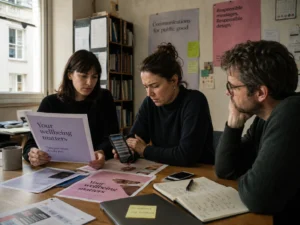
A campaign can carry a responsible message while being distributed through an experience that pressures people. Trust is also designed.
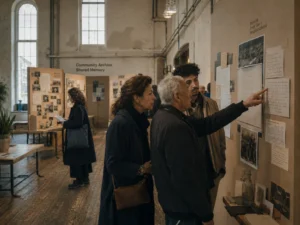
Cultural practices can support civic repair by creating recognition, shared presence and institutional learning without reducing culture to propaganda.